It has been found in Palma Bay, around three kilometres from the port. This finding represents the westernmost record of the species in the Mediterranean and the first in Spain. The research team, which includes scientists from CEAB, points to the “tropicalisation” of the Mediterranean as a factor facilitating its expansion.
Researchers from the Mediterranean Institute for Advanced Studies (IMEDEA, a joint centre of the CSIC and the University of the Balearic Islands), together with scientists from the Blanes Center for Advanced Studies (CEAB-CSIC) and the Balearic Centre for Applied Biology, have detected for the first time in the Balearic Islands the presence of the tropical invasive seagrass Halophila stipulacea.
The finding, located in the Bay of Palma, represents the westernmost record of this species known so far in the Mediterranean and the first documented in Spain. The study, led by researchers from IMEDEA, highlights the progressive advance of biological invasions in the context of ocean warming. The results were recently published in the journal Mediterranean Marine Science.
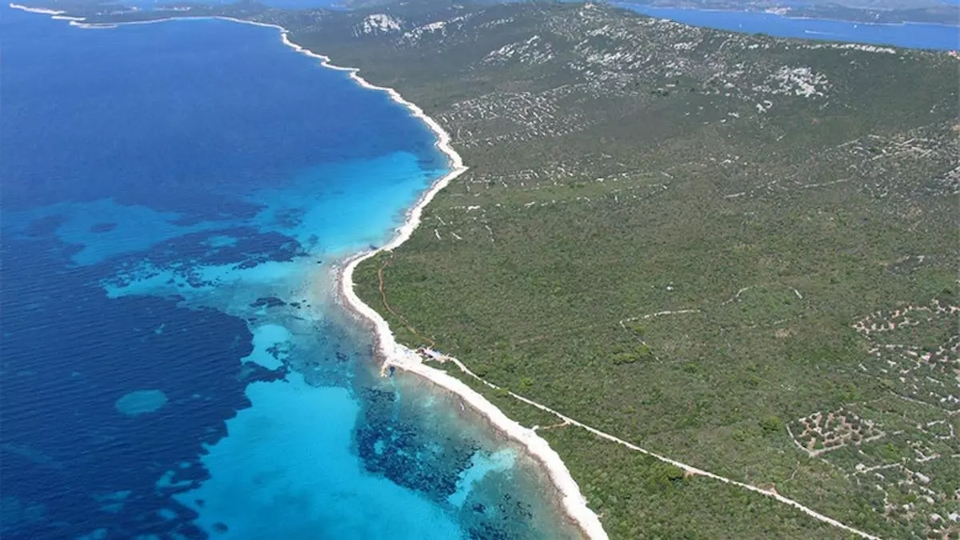
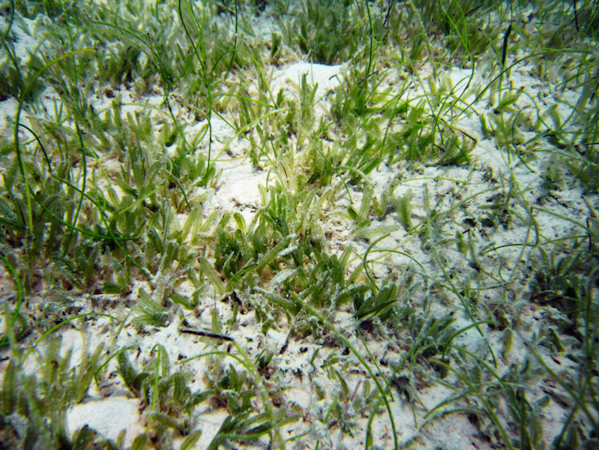
The first observation occurred in October 2023, about three kilometres from the Port of Palma, following a report from the Balearic Centre for Applied Biology. The research team subsequently carried out dives and underwater surveys that confirmed the presence of small patches established on sandy seabeds.
“This record confirms that the invasion of Halophila in the Mediterranean continues to move westward,” explains IMEDEA researcher Andrés Arona, first author of the study. “It is also a clear sign of the ‘tropicalization’ of the Mediterranean: if this species is managing to establish itself here, it is because environmental conditions are changing.”
A species with high invasive potential
Halophila stipulacea is a seagrass native to the Red Sea, the Persian Gulf and the Indian Ocean. It reached the Mediterranean after the opening of the Suez Canal more than 150 years ago and is considered one of the first “Lessepsian” species, meaning those that colonized the Mediterranean from the Red Sea through this artificial connection.
Although its expansion in the western Mediterranean has been slow, in other regions such as the Caribbean its behaviour has been far more aggressive.
“In the Caribbean, in less than 20 years, it has colonized large areas and displaced native species,” says Arona. “In the eastern Mediterranean it is already much more established; its arrival and establishment in the Balearic Islands is another step in that expansion.”
IMEDEA researcher Fiona Tomàs stresses that the discovery should not be interpreted as an isolated event:
“We are becoming ‘tropicalized’. The Mediterranean is warming and becoming increasingly favourable for tropical species. For example, other tropical species of algae and fish are already established in the eastern Mediterranean, and some are now also present along the Balearic coasts.”
Why now?
The team considers it likely that the species may have previously reached the Balearic Islands through maritime transport but failed to find suitable conditions to survive.
“It may have arrived earlier without becoming established,” says Tomàs. “Now temperatures are higher, which may be facilitating its settlement.”
In summer, the plant can grow rapidly in water temperatures close to 30 °C, values that have recently been recorded in the Balearic Sea.
The proximity of the finding to a port reinforces the hypothesis that maritime transport—particularly through anchors, ship hulls or ballast water—is one of the main pathways of dispersal.
Ecological impacts: opportunities and risks
The potential ecological impact of the species will depend on its future expansion and the type of habitat it colonizes.
In degraded sandy-bottom areas, its presence could increase structural complexity and attract new species, but it could also displace soft-bottom species. In the Balearic Islands, a similar phenomenon has already been observed with the invasive tropical alga Halimeda incrassata, which has displaced the “pedaç” (Bothus podas), a flatfish of importance for local fisheries.
If it were to displace native seagrasses such as Posidonia oceanica or Cymodocea nodosa, the impact could be even greater.
“Posidonia is like a sequoia; Halophila is much smaller,” explains Tomàs. “It does not create such complex structures nor store carbon on the same scale. A shift in species dominance can profoundly alter the ecosystem.”
In the Caribbean, biodiversity has been observed to decrease in some areas colonized by Halophila compared with native seagrass meadows. In the eastern Mediterranean there is also evidence of displacement of local species.
Early detection and a signal of change in the Mediterranean
The team highlights that detection at an early stage is key to evaluating its evolution and designing monitoring strategies.
“The earlier we detect these species, the greater our capacity to understand how they spread and what effects they produce,” says Arona. The researcher also highlights the role of citizen science and platforms such as Observadores del Mar in the early identification of new invasions.
The team is currently conducting monitoring work to assess the real extent of its expansion, its interactions with other species, and possible grazing by herbivorous fish and other organisms.
Beyond this specific case, the researchers consider the discovery to be a sign of a broader process.
“The fact that this species is here and establishing itself is not a coincidence,” concludes Arona. “It is a consequence of Mediterranean warming and increasing maritime connectivity. If our sea continues to resemble the Caribbean more closely, we will see more and more tropical species establishing themselves along our coasts.”