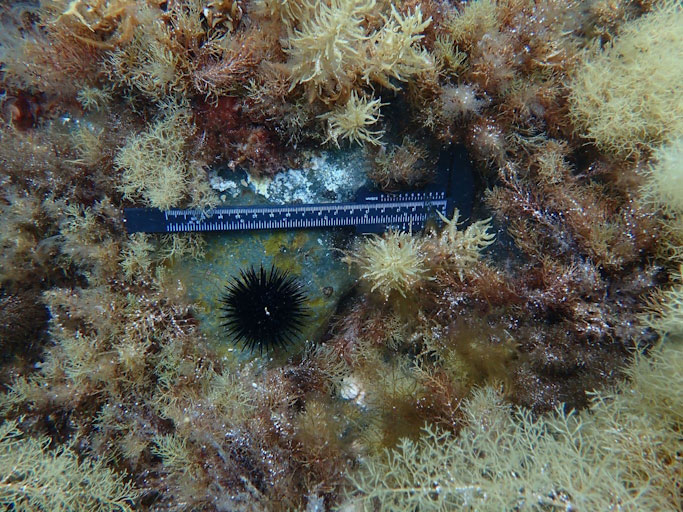
A study led by the Centre for Advanced Studies of Blanes (CEAB-CSIC) proposes a new and simple method to assess the condition of shallow rocky Mediterranean ecosystems: monitoring the grazing “halos”, the bare rock circles left by sea urchins as they feed. Incorporating this indicator would help anticipate ecosystem degradation, prioritise vulnerable areas and, ultimately, improve the management of shallow marine habitats.
For the research, published in Ecology, more than a thousand halos were analysed — 1,211 in total across 31 locations in the western Mediterranean. Sea urchins create these barren circles around themselves as they feed repeatedly on the algae that cover rocky seabeds.
The size of these rings reflects how vulnerable marine vegetation is to overgrazing. For this reason, the research team considers the halo a reliable yet simple indicator of the health of these coastal rocky Mediterranean ecosystems.
Mario Minguito-Frutos, researcher at Ifremer and lead author of the study, explains: “What we might see as a simple patch of bare rock is, in fact, an ecological thermometer. And the size of that circle tells us how vulnerable the ecosystem is to herbivore pressure. We must remember that if the vegetation disappears, everything else goes with it: all the biodiversity that depends on it, and also the benefits these ecosystems provide, such as improving water quality.”
The study reveals that halo size is influenced by endogenous factors (such as the species or size of the sea urchin) and exogenous ones (such as depth or nutrient availability. The rings tend to have a larger radius in deeper waters, in nutrient-poor areas, in habitats where large urchins are abundant, and where the species Arbacia lixula — the black sea urchin — proliferates. This species produces halos that double (25–30 cm radius) those created by Paracentrotus lividus, the common sea urchin. The results also indicate that halos grow larger in areas without environmental protection.
Marine Protected Areas: the role of predators
The data collected in the study shown a marked difference between areas with and without environmental protection. Protected areas present smaller rings, highlighting that fishery regulations and other conservation actions have a very positive effect on vegetation recovery and, therefore, on the health of these ecosystems.
Teresa Alcoverro, researcher at CEAB-CSIC and co-author of the study, stresses the role of predators: “We see that when there are fish that feed on sea urchins, the population stays under control and the remaining individuals graze less. This is the effect of what we call the ‘landscape of fear’. They know predators are around and choose to feed — and expose themselves — for less time.”
The team emphasises the importance of understanding the condition of marine ecosystems and acting to conserve them, and recalls the urgency of doing so in the Mediterranean, one of the regions of the world most affected by global change driven by human impacts.
Herbivores adopting a surprising strategy
The problem of overgrazing in marine ecosystems is not limited to sea urchins. A recent study by much of the same research team, published in Scientific Reports, reveals a surprising tactic used by tropical herbivorous fish that have arrived in the Mediterranean.
They infiltrate shoals of native fish. Since the locals do not perceive them as a threat, they allow the newcomers to join. The exotic fish benefit from the group’s knowledge of the environment, from the protection it offers and from the camouflage it provides, enabling them to feed for longer and more intensively.
The final result is an overall increase in grazing pressure, adding to that exerted by other herbivores such as sea urchins, and accelerating the degradation of already vulnerable habitats such as marine forests.
Article reference: Minguito-Frutos, Mario, Rohan Arthur, Jordi Boada, Candela Marco-Méndez, Matthew P. Adams, Jordi F. Pagès, Xavier Buñuel, et al. 2025. “Grazing Halos Reveal Differential Ecosystem Vulnerabilities in Vegetated Habitats.” Ecology 106(11): e70239. https://doi.org/10.1002/ecy.70239
Article reference: Minguito-Frutos, M., Buñuel, X., Marco-Méndez, C. et al. Tropical range extending herbivorous fishes gain foraging benefits by shoaling with native temperate species. Sci Rep 15, 35137 (2025). https://doi.org/10.1038/s41598-025-19136-x