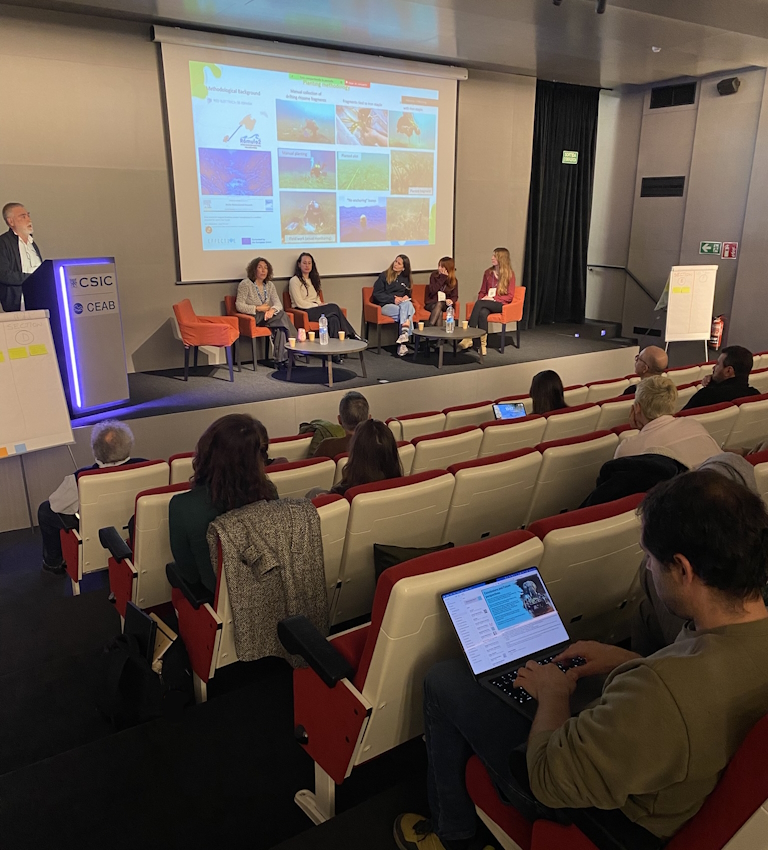
The Centre d’Estudis Avançats (CEAB-CSIC) hosted a scientific workshop on 25 February devoted to the ecological restoration of marine habitats, bringing together experts in conservation and restoration. The session was held within the framework of the European project EFFECTIVE (Horizon Europe), taking place in Blanes and coordinated by CEAB-CSIC researcher Rafael Sardá.
Among the keynote speakers was Simonetta Fraschetti, Professor at the Università degli Studi di Napoli Federico II and an internationally recognised expert in marine ecology, conservation and the restoration of coastal ecosystems. She emphasised a central message: restoration can only be effective if, before, during and after the process, there is a sustained reduction in the pressures that led to habitat degradation — in most cases of human origin — together with a solid and long-term conservation strategy.
Conservation as a prerequisite
During the workshop it was stressed that ecological restoration cannot be conceived as an isolated action or as a quick fix to environmental degradation. Conservation is a prerequisite before, during and after any ecological restoration initiative.
The experts agreed that investing in restoration makes little sense unless the causes of ecosystem collapse or degradation are addressed. This requires, first and foremost, effectively reducing human pressures such as pollution and overexploitation, to name just two.
“Mitigation and preservation are the priority. Without eliminating or significantly reducing pressures, restoration makes little sense, as it cannot achieve real success,” was one of the key ideas highlighted by CEAB-CSIC researchers Emma Cebrian and Teresa Alcoverro during the session.
Restoring ecosystem functionality
The researchers also noted that restoration cannot be limited to recovering species or physical structures, but must aim to re-establish the ecological functionality of marine ecosystems.
This approach, focused on restoring ecological processes and enhancing ecosystems’ capacity to respond to new disturbances, is essential to ensure that restoration actions are effective in the long term.
Restoration and commitment
Another central topic of discussion was the cost and complexity of restoration. It is a demanding process in economic, logistical and scientific terms, requiring long-term planning and an appropriate management framework.
In this regard, Rafael Sardá stressed that restoration initiatives should prioritise areas where there is a genuine commitment to reducing pressures and implementing management changes. Without such structural and governance commitments, restoration may prove inefficient or short-lived. The CEAB-CSIC researcher also underlined that the scientific community cannot limit its dialogue to public administrations. To achieve real impact, he noted, it is also necessary to engage with the private sector. Involving these actors is key to meeting conservation and restoration objectives.
The workshop concluded with a shared reflection on the need for a new conceptual framework in the relationship between society and marine ecosystems. Restoration, participants agreed, cannot replace the profound transformation required in the way humanity interacts with the natural environment.
The European project EFFECTIVE
This approach is aligned with the objectives of EFFECTIVE, funded by Horizon Europe and coordinated from CEAB-CSIC.
The project aims to develop evidence-based tools and strategies to improve the effectiveness of marine protected areas and advance the conservation and restoration of coastal ecosystems.