Skip to content

Beyond the current: Improving European flowing waters in an era of global change (BEYOND)

BEYOND

investigadores_treballant_riu
The BEYOND project, a MSCA Doctoral Network, will train the next generation of water professionals to tackle European water quality challenges in the context of climate change and emerging contaminants. Researchers will gain interdisciplinary skills, access to cutting-edge technologies, and expertise in water management to drive innovation and improve water quality.

BEYOND will train the next generation of water professionals who will deliver scientific and technological innovation across disciplines, institutions and countries needed to solve European water quality problems in an era of global change. In the last decade, some improvement in understanding of water pollution has been achieved but there are still significant knowledge gaps, especially in the context of climate change and emerging contaminants, coupled with a lack of systems approach and operational tools required by water management.

To address water quality pressures, we need to better target heterogeneity in the land-water continuum, accounting for recipient-specific sensitivity to pollution pressures and the spatial and temporal variation in sources, pathways, and impacts on stream ecology and ecosystem services, now and under future climatic conditions.

BEYOND will equip Researchers with critical technical and communication skills needed to provide evidence-based management of landscapes and river networks under current and future conditions. They will gain expertise in interdisciplinary catchment science, novel high-resolution water quality sensors and models, gain access to cutting-edge water quality instrumentation in experimental catchments in Europe and through secondments to SMEs, and skills in citizen science. BEYOND Researchers will become leaders in innovation and knowledge exchange needed to achieve water quality improvements, through effective interactions with public and private stakeholders during secondments and short visits.

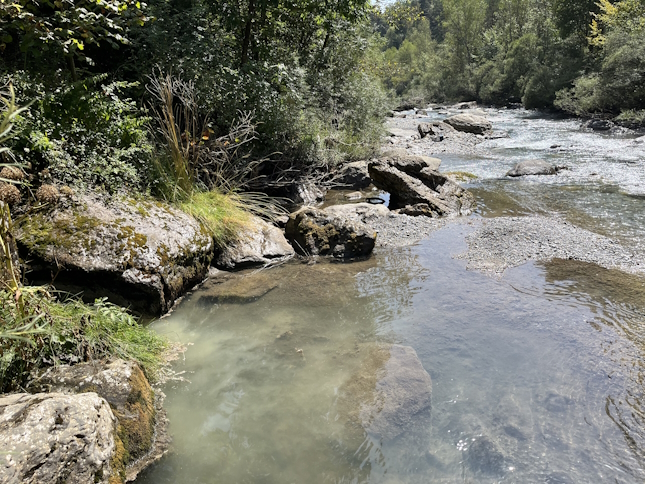
Cover image: Fieldwork from a previous research project. Author: X. Peñarroya / CEAB-CSIC.
General project information

Development period
Start

01/01/2025

End

31/12/2028

Department

Responsible researcher

Tenured Scientist | Head of Department of Ecology of Inland Waters

Funding entities

funded-european-union

Institutions/collaborators

Social networks of the project

You may also be interested in

By studying the relationship between rivers, aquifers, and terrestrial environments, ENEO3 examines how natural self-purification processes can help improve water quality. The project focuses on denitrification, a key biogeochemical process that converts nitrates into nitrogen gas, thereby reducing water pollution caused by excess nitrogen.
The BlauCat project aims to assess the current status of blue carbon in Catalonia’s coastal ecosystems and contribute to the development of an action plan for their conservation and restoration, as a tool to support public policies for climate change mitigation and adaptation. The project will generate a homogeneous and georeferenced database on blue carbon stocks and fluxes at the regional scale, as well as an analysis of the restoration potential of these ecosystems.
The main objective of this research project is to co-develop digital twins for predicting water quantity and quality in the Ter and Tordera basins, including catchments, reservoirs and coastal areas, contributing to efficient water resource management, protecting ecosystems and maximising water security in a climate change context.
It focuses on detailed taxonomic analysis and trophic-functional assessment of soft-bottom macrobenthos in various regions worldwide, with the aim of providing rigorous scientific advice to support the completion of environmental monitoring and impact management studies for projects.
The project aims to design nature-based wastewater treatment solutions specifically adapted to high-mountain conditions.