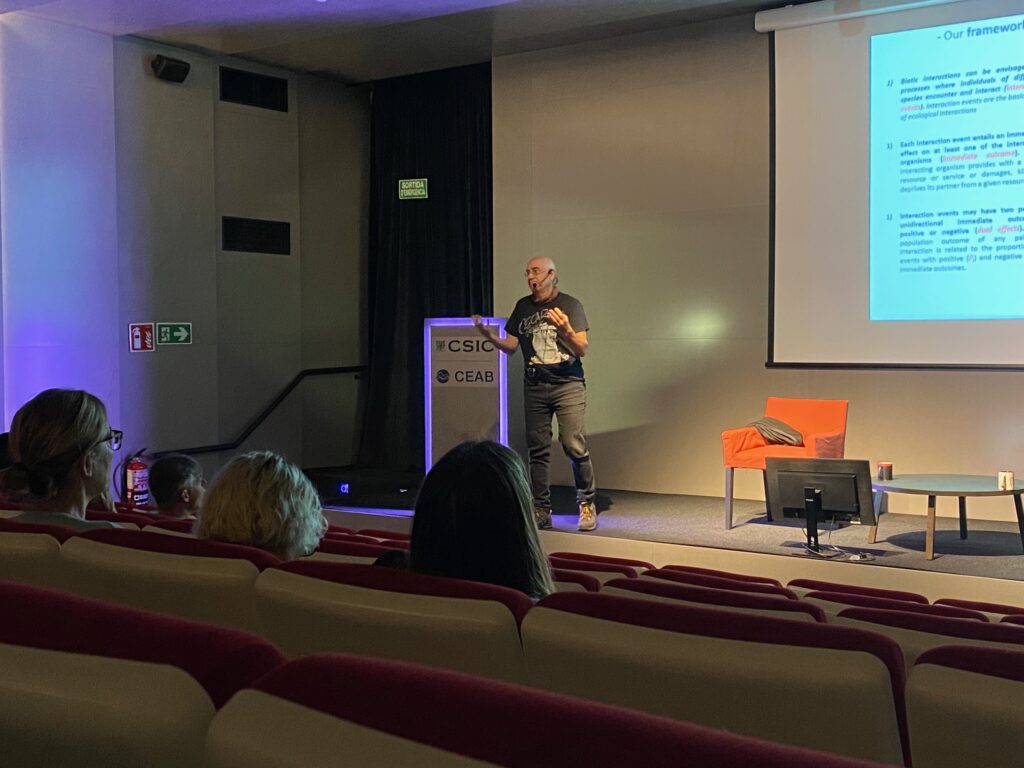
On 22 April, the Centre d’Estudis Avançats de Blanes (CEAB) hosted a new session in its scientific seminar series featuring leading invited researchers, organised through the MaX-CSIC programme. The series is designed to foster contact between researchers and external perspectives that can stimulate new questions and more transformative research. In this context, José María Gómez Reyes presented a seminar revisiting one of ecology’s classical frameworks: the rigid separation between mutualism and antagonism.
Gómez is Professor of Ecology at the University of Granada and Research Professor at the Experimental Station of Arid Zones (EEZA-CSIC). His research focuses on the evolutionary biology of species interactions and on how these relationships shape ecosystem functioning.
In his lecture, entitled The Fuzzy Logic of Ecological Interactions, he argued that many ecological interactions do not fit neatly into fixed labels such as “mutualistic” or “antagonistic”. At the core of his proposal is the idea that the outcomes of many biotic relationships are not static, but lie along a continuum between positive and negative effects, because organisms often impose both benefits and costs on their interactors at the same time.
This implies a significant reformulation of the classical framework used to describe species interactions. Rather than viewing them as fixed boxes, the proposal places mutualism and antagonism as positions along a gradient. This distribution of effects is not simply a consequence of environmental or contextual variation, but is also framed as an inherent property of many biotic interactions, arising from the simultaneous beneficial and detrimental effects organisms exert on one another.
One of the central points of the seminar was the presentation of a new mathematical model developed by Gómez and colleagues that describes species interactions as a gradient of effects — from more beneficial to more harmful — rather than classifying them into fixed categories.
One of the most illustrative examples is synzoochory, the dispersal of seeds by animals that may simultaneously act as seed predators. This case offers a particularly clear expression of a central idea in Gómez’s research: the same species can be both ally and threat within a single ecological relationship.
The seminar also highlighted how this continuous perspective may help interpret more realistically the architecture of ecological communities. Combining different types of interactions helps address questions such as community robustness and responses to disturbance or species loss.
A key message of the session was that nature is often explained less well when forced into overly neat dichotomies. The new model presented by Gómez formalises this complexity by representing ecological interactions as a continuum of effects, rather than as fixed categories.
An Eco-evolutionary View of Same-sex Behaviour in Mammals
The second part of the event, in an interview-colloquium format with CEAB researcher Daniel Oro, focused on José María Gómez’s research on same-sex sexual behaviour in mammals — explicitly excluding humans — approached from an eco-evolutionary perspective. Gómez explained that such behaviours are more frequent in social species, pointing to a close relationship between sociality and the evolution of these behaviours.
He also distinguished different patterns in males and females. In males, these behaviours occur more often in species showing intraspecific violence and are proposed as a possible mechanism for reducing or modulating conflict. In females, by contrast, this association with violence is not observed, suggesting different evolutionary dynamics, probably linked more to social cohesion than to conflict management.