A new study experimentally demonstrates that bacterial colonies belonging to different species can transfer antibiotic resistance genes when they come into physical contact, and that factors such as the initial distance between colonies influence the extent of this transfer.
Antibiotic resistance is one of the major threats to global health. One of the ways it spreads is through the exchange of genetic material between bacteria. In particular, some resistance genes are carried on plasmids, small DNA molecules that bacteria can transfer to one another, enabling them to acquire new traits, such as the ability to withstand the action of an antibiotic.
Until now, extensive research has examined how this transfer occurs within a single bacterial colony. In contrast, much less was known about what happens between distinct, physically separated communities that eventually meet and come into contact.
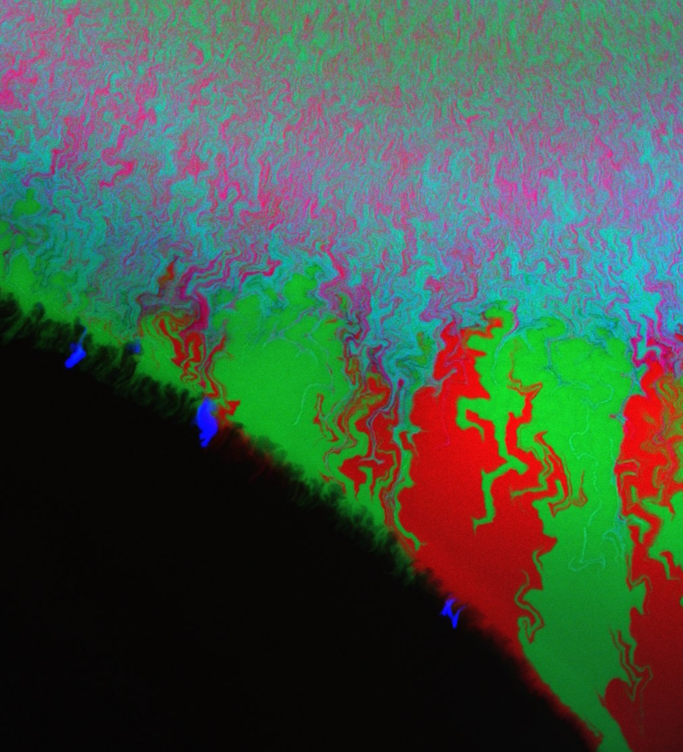
This research, published in the scientific journal mSystems, sheds new light on the issue. The research team placed two bacterial communities at different locations on the same laboratory plate. One community consisted of bacteria of the species Stutzerimonas stutzeri and carried antibiotic resistance genes, while the other, composed of Escherichia coli, did not. The researchers allowed both colonies to expand until they collided and observed that, upon contact, the first community transferred resistance genes to the second.
“We often focus on biological factors to explain the problem of bacterial antibiotic resistance, but something as fundamental as the spatial distribution of organisms plays a key role in the spread of resistance,” explains Josep Ramoneda, who led the study. At the time of the research, he was affiliated with the Swiss Federal Institute of Aquatic Science and Technology (Eawag) and is now a Ramón y Cajal researcher at the Centre for Advanced Studies of Blanes (CEAB-CSIC).
Distance and spatial organisation are key factors
The experiment showed that the number of resistance genes transferred depends on the initial distance between bacterial communities. Maintaining resistance is costly for bacteria, meaning that as the donor colony expands, fewer and fewer bacteria retain the resistance genes, since those that lose them eventually outcompete the rest. Consequently, the sooner the colonies come into contact, the greater the transfer, a phenomenon that had previously only been described theoretically.
The spread of resistance also depends on how cells are distributed within each community. When bacteria carrying resistance genes are more thoroughly mixed with those that do not carry them, there are more contacts between the two groups and therefore more opportunities for gene transfer. By contrast, when populations are more spatially segregated, this exchange decreases.
“It is not enough to know which bacteria are present or which resistance genes they carry. We also need to understand how they are organised in space, because this organisation strongly influences how resistance spreads,” says Ramoneda.
A model for predicting resistance spread
Based on the experimental results, the team developed a computational model that simulates the growth, genetic dynamics and collision of bacterial communities. The model incorporates factors such as the distance between colonies, the location of cells carrying resistance genes, the degree of mixing between different populations, and the likelihood that genetic material will be transferred or lost.
This makes it possible to predict the conditions under which resistance is more likely to spread from one bacterial community to another, as well as those under which its spread is likely to be more limited. The study therefore links processes occurring between individual bacteria with the way entire microbial communities are organised and interact.
Potential applications in healthcare and water treatment
The findings could help improve the prediction and control of resistance spread in environments where microorganisms grow attached to surfaces. These include medical devices, chronic wounds and dental plaque, but also pipelines, water distribution systems and wastewater treatment facilities.
Understanding how distance, physical contact and community organisation shape gene transfer could help, for example, in designing surfaces that hinder the formation and connection of bacterial colonies, or in identifying locations and conditions where resistance genes are most likely to spread.
At a time when antibiotic resistance is increasing worldwide, improving our understanding of the mechanisms that facilitate or limit its spread is essential for developing more effective prevention and control strategies in both healthcare and environmental settings.