La Conversa, the catalan edition of The Conversation, launches with an article by one of our researchers that highlights the value of taxonomy — the discipline that identifies, describes and rigorously classifies the species discovered by science.
(The article by Daniel Martín Sintes and María Capa Corrales, published in La Conversa on 27 April 2026, is reproduced below)
The human fish, the DiCaprio tree, the Chewbacca wasp or cave-dwelling spaghetti worms: naming new species is a far more complex task than is often perceived from the outside, and one in which only the most anecdotal or curious aspects tend to attract attention. But how do scientists actually proceed when we discover a new species?
The first step is the discovery of an apparently unknown organism. Recognising it as such is the responsibility of taxonomists — scientists specialised in the study, description and classification of species. This work involves thoroughly documenting morphology and justifying, using objective criteria, why it represents a distinct entity from all those previously described.
First name and surname
The binomial system, along with the first classification systems for living organisms, was established in the early 18th century by Carl von Linné. At that time, the language of scientific communication was not English but Latin, which is why scientific names follow the grammatical rules of that language.
Each new species is assigned a binomial scientific name consisting of two words. The first is the genus name — the “surname” — which indicates the species’ relationship with other closely related organisms. The second is the specific epithet — the “given name” — which distinguishes each species within its genus. Together, they form a unique, unambiguous and universal name.
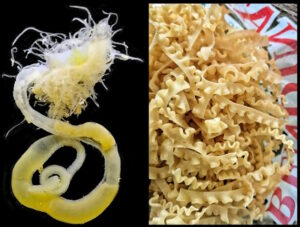
Local cuisine as a source of inspiration
In 2025, as part of the BIOCAVE project, we discovered in an anchialine cave in the Balearic Islands a new species of worm from the terebellid family, commonly known as spaghetti worms.
The distinctive features of this new worm could have led to a name related to its morphology, its cave habitat or its geographical distribution. In fact, the proposal we adopted combined all three aspects: as it was a Balearic spaghetti worm, we chose a name rooted in Mallorcan culinary culture, referring to a type of pasta similar to spaghetti traditionally produced in the town of Porreres. Thus, the new species was named Polycirrus burballes, and the published etymology states:
The species name burballes, which in Mallorcan Catalan means ‘shavings’, also refers, in Mallorcan cuisine, to a type of pasta similar to spaghetti traditionally produced in the town of Porreres. It is used here as a noun in apposition to playfully allude to the common name ‘spaghetti worms’, by which terebellids are known.
Panamanian ‘Fraggles’
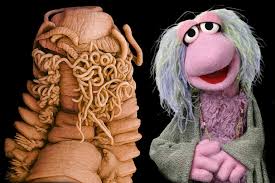 Spaghetti worms are undoubtedly a good source of inspiration for curious names, given their somewhat outlandish appearance. Another good example is Thelepus fraggleorum, which we found on Coiba Island (Panama). In fact, we could call it a “fraggle worm”, since, as its etymology explains:
This species is dedicated to the Fraggles (the characters created by Jim Henson), extraordinary creatures who live in Fraggle Rock and share certain similarities with this new species. Neither Thelepus fraggleorum nor the Fraggles have ever been to the hairdresser…
Alternative lifestyles: geographical locations and squatters
Geographical locations are another common source of inspiration, and their names reflect the area where species were discovered or where they have a characteristic distribution. Among them are species such as Peudomastus deltaicus, discovered in the Ebro Delta; Marphysa gaditana, from Cádiz (Gadir in Latin); Paraelhersia knisnaensis, from Knysna Bay (South Africa); Inermonephtys brasiliensis, from the Brazilian coast; and Ophriotrocha mediterranea, widely distributed in the Mediterranean Sea.
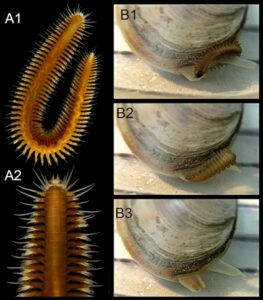
A different case is that of a polychaete from the hesionid family that we discovered along the southern coasts of the Iberian Peninsula. Although most members of this family are free-living, this species was consistently found inside bivalve molluscs of the razor clam group.
This hesionid belongs to the genus Oxydromus, and its peculiar lifestyle inspired the name Oxydromus okupa, as explained in the etymology of the original article:
The specific epithet okupa refers to the squatter movement that emerged in Spain in the 1980s as a response to the increasing difficulty of accessing housing. Squatting consists of occupying empty buildings for one’s own use and involves forms of self-organisation and alternative modes of interaction, in parallel with how these symbiotic polychaetes interact with their hosts and the wider ecosystem.
To mimic or not to mimic? That is the question
A symbiotic worm that lives exposed on the body of its host, rather than sheltering among rocks or sediments, could easily become prey for numerous predators. This selective pressure has favoured the development of various defensive strategies, among which mimicry stands out, giving rise to particularly striking shapes and colour patterns. These characteristics are often reflected in scientific names.
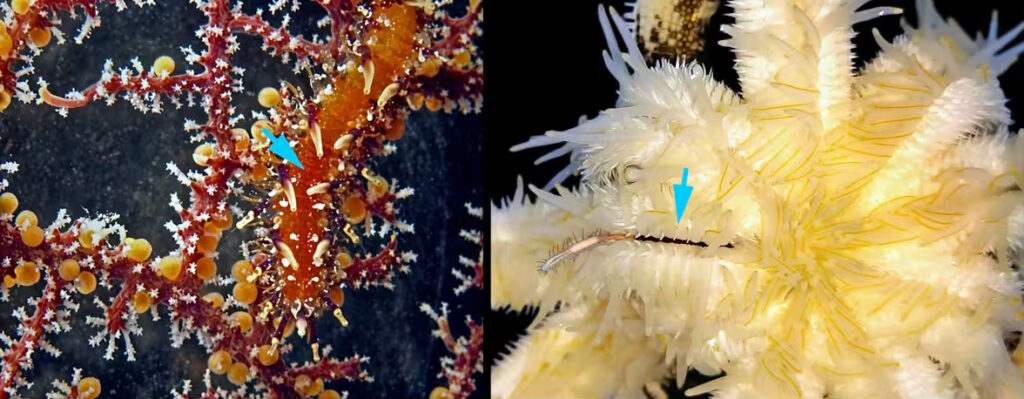
A paradigmatic example is a species of polynoid, or scale worm, that we found in Sulawesi (Indonesia) and the Ogasawara Islands (Japan). The worm not only lives among the branches of its host, but also camouflages itself by remarkably imitating its colouration: violet branches, white polyps and orange reproductive organs. This spectacular mimicry inspired the name Medioantenna variopinta.
Medioantenna and Inermosyllis. Authors of the article.
We sometimes also turn to more poetic names, such as that of a small worm we named Sphaerodorum ofiurophoretos, meaning “carried by an ophiuroid” (‘phoretos’ means ‘carried’ in Greek). Another example is the syllid associated with a starfish that we named Inermosyllis asteriakavalaris, meaning “starfish rider”, derived from the Greek words ‘asterias’ (starfish) and ‘kavalaris’ (rider).
Tributes
Taxonomists, as specialists, receive tributes in the form of new species names from their colleagues, as in the case of the scale worm Anotochatetonoe michelbaudi, dedicated to the French taxonomist and ecologist Michel Bhaud.
The authors of this text have also been honoured in the same way with species such as Syllis danieli and Hololepidella martini, or Brevicirrosyllis mariae and Lygdamis mariae.
The most moving recognitions are undoubtedly those granted posthumously. One example is Syllis kikeballesterosi, dedicated to our friend and marine ecologist Enric “Kike” Ballesteros. However, one that has moved us most deeply is Lumbrineris jan. Its etymology, paraphrasing the final line of Frank Capra’s 1946 film It’s a Wonderful Life, reads:
The specific epithet jan is a noun in apposition. The species is dedicated to the loving memory of Jan Ventura Buchaca (2008–2020), a brave young boy, son of Teresa and Marc and brother of Sara. “Every time a bell rings, an angel gets his wings”, but Jan received his far too soon.
Researching, describing and naming species constitutes an essential first step towards conserving the ecosystems that form part of our shared natural heritage. And if, in addition, those names can be imbued with meaning and the process experienced with passion and enjoyment, what more could taxonomists ask for?