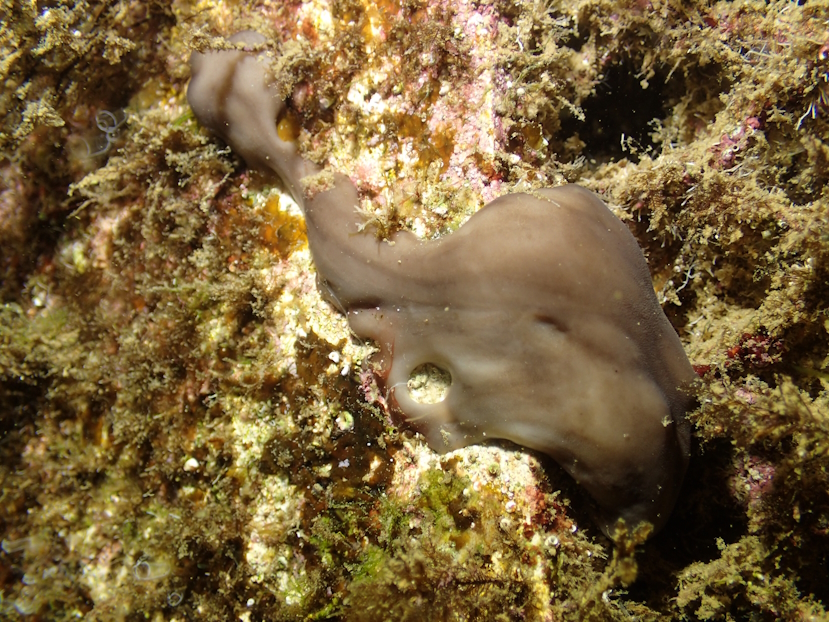
A scientific study identifies Chondrosia reniformis as a promising species for the renaturalisation of degraded harbour environments.
Harbours are essential environments for human activities, but they are also among the most heavily altered marine habitats. Pollution, limited water renewal and the physical transformation of coastlines make it difficult for many native species to survive and hinder the recovery of biodiversity. Now, a new study, published in Frontiers in Marine Science, has identified an unexpected ally for ecological restoration in these habitats: a sponge capable of surviving and thriving under these adverse conditions while acting as an ecosystem engineer, promoting the recovery of marine life. The journal has highlighted the study for its scientific significance and its implications for the restoration of coastal ecosystems.
The research, led by Manuel Maldonado and Carlota Escarré from the Sponge Ecobiology and Biotechnology research group at the Centre for Advanced Studies of Blanes (CEAB-CSIC), in collaboration with the company Ocean Ecostructures, assessed over 455 days the ability of five Mediterranean sponge species to survive after being transplanted from their natural habitat to a marina.
The results were conclusive: of the five species studied, only one displayed an extraordinary capacity to adapt to harbour conditions. A total of 91.7% of Chondrosia reniformis specimens survived throughout the experiment, whereas the other four species failed to withstand the process. Their specimens either died shortly after being transferred to the harbour or did not even survive the preliminary preparation phase in the laboratory.
The survival of this species was not the study’s only finding. The researchers observed that it displays remarkable biological plasticity. Although it initially shrank slightly after being transferred to the harbour, it subsequently stabilised its biomass and exhibited behaviours that are unusual in these organisms. Individual sponges were able to move slowly across the substrate, travelling up to 12.7 centimetres during the monitoring period while continuously reshaping themselves to adapt to changing environmental conditions.
In addition, some specimens developed a reproductive strategy that could prove particularly valuable for restoration projects. During the warmest months of the year, they naturally divided to produce new genetically identical individuals. Thanks to this process of clonal reproduction, the experimental population increased from 24 to 40 sponges without the need for further human intervention.
The study also documented the species’ remarkable ability to recover from episodes of disease. One individual experienced several infections during the experiment, losing part of its tissues on different occasions. However, it fully regenerated after each episode and continued to develop normally—a particularly valuable trait in environments exposed to multiple stressors.
CEAB-CSIC researcher Manuel Maldonado highlights: “The remarkable ability of Chondrosia reniformis to move gives it an unusual ecological advantage. It can change its position if local conditions deteriorate or if competition for food or space increases, and it can seek refuge in areas that offer greater protection from pollution, predators or other stressors. This ability, together with its resilience and its capacity to reproduce by division, producing clones, makes it an exceptionally robust species and an excellent candidate for ecological restoration projects in harbour environments.”
Sponges on Artificial Reefs to Restore Biodiversity
Sponges play an essential role in the functioning of marine ecosystems. They filter large volumes of water, removing bacteria and viruses, recycle essential nutrients and provide shelter for numerous organisms. For this reason, they are regarded as ecosystem engineers, capable of modifying their environment in ways that facilitate the establishment of other species.
The authors stress that the aim of the study was not to demonstrate that sponges alone can restore a degraded harbour, but rather to identify species capable of tolerating the conditions found in these environments so that they can be incorporated, together with other organisms, into renaturalisation strategies.
 To monitor the sponges, the research team developed an innovative methodology based on underwater photography, artificial intelligence and mathematical models. Using computer vision algorithms, they automatically analysed the development of each specimen, reconstructing almost continuously changes in its size, shape and movement over more than a year. This approach provides a highly accurate tool for studying slow-growing organisms and for supporting the design of future ecological restoration initiatives.
The project also incorporated a technological innovation developed by Ocean Ecostructures. The sponges were attached to plates made from recycled ceramic materials, which were in turn installed on metal structures coated with a layer of calcium carbonate produced through electrolysis in seawater. These structures, known as Life Boosting Units, facilitate the natural settlement of other organisms around the sponges, reinforcing their role as habitat engineers.
The team points out that, in the context of coastal urbanisation, the renaturalisation of harbours will depend on solutions that combine ecological engineering with native species that are sufficiently resilient to thrive in degraded environments. The case of Chondrosia reniformis, the researchers conclude, offers a promising pathway towards harbour infrastructure that is more compatible with marine life.