Skip to content

The pH-alkalinity gradient in space and time, an ecological framework for freshwater biodiversity (ALKALDIA)

ALKALDIA

This work focuses on addressing our general hypothesis that local diatom communities respond to the direct and watershed-mediated effects of the current increase in atmospheric CO2, providing insight into small-scale alkalinity generation mechanisms.

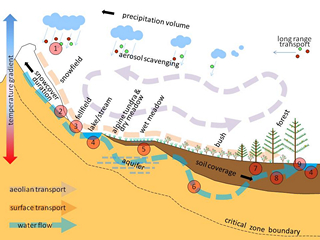
The overall aim of this project is to elucidate the biogeochemical processes that control the pH-alkalinity variation at fine scales in mountain aquatic sistems (e.g. microhabitats, interannual and decadal tendencies and fluctuations, changes across vegetation gradients), providing the reference to characterize the fluctuations that local diatoms communities may experience. This work is focused to address our general hypothesis that local diatom communities are responding to direct and catchment-mediated effects of the current atmospheric CO2 increase, by providing insight into the small scale mechanisms of alkalinity generation. Our specific working hypothesis in this subproject is that the aggregation of such fine scale mechanisms gives rise to mesoscale patterns/gradients of alkalinity (both in space and time), that are the ecological framework in which local communities evolve. The conceptual basis for this analysis is the Landscape Continuum Model (LCM) applied to high mountain catchments.

Duration: June 2020 – May 2023

Funding Agency: Ministerio de Ciencia e Innovación

LOOP participants: Jordi Catalan, Marisol Felip, Lluís Camarero, Sergi Pla

Coordinators : Jordi Catalan, Lluís Camarero

Participant institutions: CREAF, University of Barcelona, CEAB-CSIC
General project information

Development period
Start

June 2020

End

May 2024

Department

Responsible researcher

Tenured Scientist

Other researchers and involved staff

Funding entities

Institutions/collaborators

Social networks of the project

You may also be interested in

An innovative initiative that brings together science, art, music, literature, and new technologies (augmented reality). Its primary objective is to increase knowledge and understanding regarding the impacts of the climate emergency on freshwater ecosystems, while highlighting female voices across three key areas: research, vulnerability, and agents of change.
Within the framework of the Monitoring and Control Programme (PSiC) of the Catalan Water Agency (ACA), an agency of the Government of Catalonia.
The main objective of the project is to expand basic knowledge regarding the biology and ecology of this species and its population in Menorca (Balearic Islands).
Its aim is to define Catalonia’s marine restoration strategy through a rigorous assessment of the condition of marine habitats, the identification of pressures and threats, and the establishment of realistic and measurable objectives, as well as the implementation of pilot restoration projects.