Skip to content

Best chemical risk assessment professionals for maximum ecosystem services benefit (PRORISK)

PRORISK

prorisk
PRORISK's vision is to provide exceptional value by creating an innovative platform to train a network of early stage researchers (ESR) in the field of Environmental Risk Assessment (WAS).

Project colaboration

Vision of PRORISK is to provide a unique value by creating a novel platform for training a network of Early Stage Researchers (ESRs) in the field of advanced Environmental Risk Assessment (ERA). ERA is nowadays rapidly changing from relying on simplified descriptive laboratory tests to incorporating mechanistic, ecological and socio-economic process information. This revolutionizes the risk assessment making it increasingly comprehensive, realistic and relevant, also under consideration of other modulating effects such as non-chemical stressors or impact of global change.
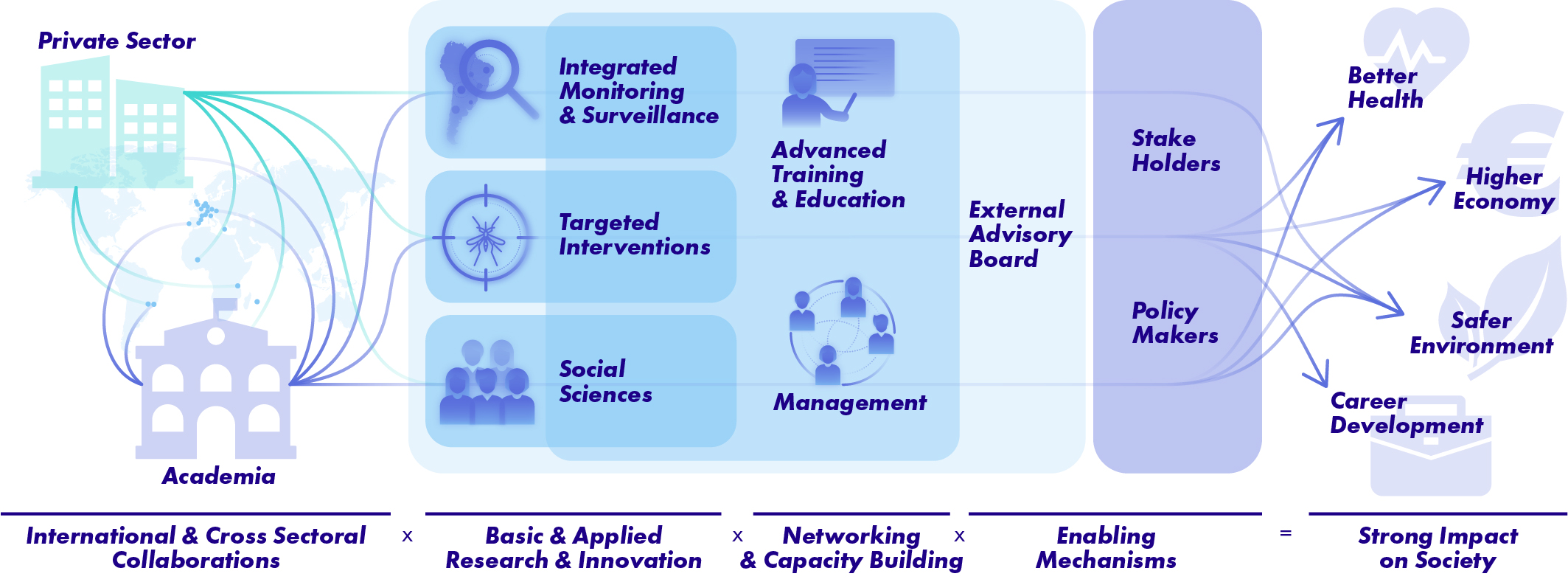
ESRs in PRORISK will gain the abilities to address this major challenge in risk assessment paradigm shift. They will work as future experts at the interface between the key concepts of sustainable protection of ecosystems and health – i.e. adverse outcome pathways (AOPs) and ecosystem services. Young researchers within PRORISK will develop and integrate mechanistic understanding, in-depth analyses of chemical-biological interactions and exposure, and functioning of ecosystems. They will be able to tackle increasingly complex data. They also will be able to critically evaluate robustness of risk predictions and assess the socio-economic costs of environmental damage. PRORISK will allow the ESRs to develop the critical capability to synthesize processes across different levels of biological organization and different mechanistic, ecosystem and socio-economical concepts. This will empower ESRs to shape future regulatory missions protecting the ecosystems services and assuring thus sustainability of ecosystem services and prosperity long beyond the PRORISK project.
General project information

Development period
Start

01/04/2020

End

-

Department

Responsible researcher

Tenured Scientist

Funding entities

Institutions/collaborators

Social networks of the project

You may also be interested in

By studying the relationship between rivers, aquifers, and terrestrial environments, ENEO3 examines how natural self-purification processes can help improve water quality. The project focuses on denitrification, a key biogeochemical process that converts nitrates into nitrogen gas, thereby reducing water pollution caused by excess nitrogen.
The BlauCat project aims to assess the current status of blue carbon in Catalonia’s coastal ecosystems and contribute to the development of an action plan for their conservation and restoration, as a tool to support public policies for climate change mitigation and adaptation. The project will generate a homogeneous and georeferenced database on blue carbon stocks and fluxes at the regional scale, as well as an analysis of the restoration potential of these ecosystems.
The main objective of this research project is to co-develop digital twins for predicting water quantity and quality in the Ter and Tordera basins, including catchments, reservoirs and coastal areas, contributing to efficient water resource management, protecting ecosystems and maximising water security in a climate change context.
It focuses on detailed taxonomic analysis and trophic-functional assessment of soft-bottom macrobenthos in various regions worldwide, with the aim of providing rigorous scientific advice to support the completion of environmental monitoring and impact management studies for projects.
The project aims to design nature-based wastewater treatment solutions specifically adapted to high-mountain conditions.