Skip to content

ESA-European Coastal Blue Carbon

ESA

By combining satellite images, remote sensors, and field data, the project will provide effective tools to help managers and policymakers monitor and assess coastal carbon ecosystems and integrate blue carbon into national climate inventories and policies.

To support the effectiveness of policies aimed at conserving and restoring coastal blue carbon (CB) ecosystems in the face of imminent climate change threats, there is an urgent need for greater knowledge and tools capable of accurately estimating and monitoring changes in CB carbon stocks across large areas and over time.

By combining satellite images, remote sensors, and field data, the project will provide effective tools to help managers and policymakers monitor and assess coastal carbon ecosystems and integrate blue carbon into national climate inventories and policies.

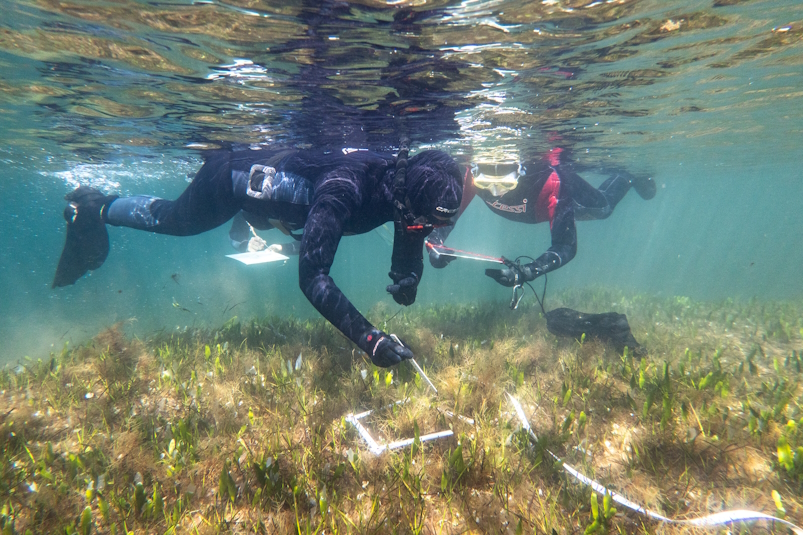
The GAME group is collaborating on this European Space Agency (ESA) project by contributing published and unpublished datasets on biomass, soil blue carbon stocks, and accumulation rates in seagrass meadows and tidal marshes in Spain and France.

General project information

Development period
Start

2024

End

2027

Department

Responsible researcher

Tenured Scientist

Funding entities

Institutions/collaborators

Social networks of the project

You may also be interested in

An innovative initiative that brings together science, art, music, literature, and new technologies (augmented reality). Its primary objective is to increase knowledge and understanding regarding the impacts of the climate emergency on freshwater ecosystems, while highlighting female voices across three key areas: research, vulnerability, and agents of change.
Within the framework of the Monitoring and Control Programme (PSiC) of the Catalan Water Agency (ACA), an agency of the Government of Catalonia.
The main objective of the project is to expand basic knowledge regarding the biology and ecology of this species and its population in Menorca (Balearic Islands).
Its aim is to define Catalonia’s marine restoration strategy through a rigorous assessment of the condition of marine habitats, the identification of pressures and threats, and the establishment of realistic and measurable objectives, as well as the implementation of pilot restoration projects.