Environmental change in Mediterranean coastal ecosystems in response to anthropogenic and climatic pressures during the Holocene.
Natural or anthropogenic disturbances are two of the main drivers of change in ecosystems, change that occurs at multiple spatio-temporal scales. Discriminating between actual state changes and cycles or trends is often difficult or impossible without proper time perspective. Thus, having long, detailed and reliable data series of relevant structural and functional variables of the ecosystem is a priority for natural resource managers. Long data series can be generated from monitoring programs or searched from human, biological or geological records. The former provide detailed and quality information, but are expensive and rarely resilient. The latter, modern paleo-reconstruction techniques, can provide an extraordinary wealth of information on biological and environmental aspects of ecosystems, collecting extensive periods of time with notable temporal resolutions.
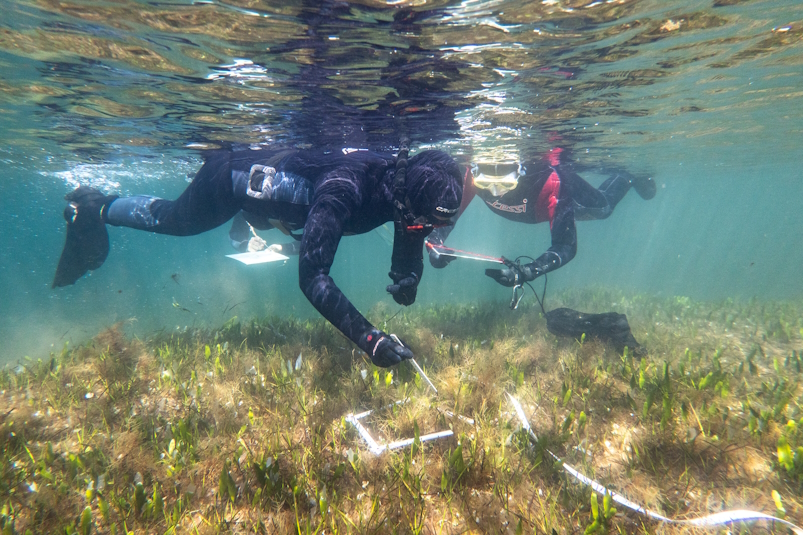
Human density along the planet’s coasts causes intense and continuous disturbances in the ecosystems of the coastal strip. The paleo-environmental approach provides valuable information about these impacts and how ecosystems respond. But the virtual nonexistence of paleo-environmental archives in exposed coastal areas has prevented further development of this valuable approach in coastal environments. Fortunately, seagrass sediments, common in these environments, constitute detailed archives of the natural history of both coastal and terrestrial ecosystems. Its sediments,
peaty and anoxic, they store information that covers at least the last 8000 years with resolutions between 1 and 10 years/cm.
MEDCHANGE will use the aforementioned files to reconstruct the dynamics of coastal and terrestrial ecosystems, on a Mediterranean scale, when interacting with natural and anthropogenic disturbances. The objectives will be addressed by an international team made up of researchers from Germany, Australia, Spain, Tunisia, Croatia, and Greece, all of them experts in Seagrass Ecology, Paleoecology and Biogeochemistry. Geological, chemical, molecular, palynological, and isotopic indicators or proxies will be studied, along with historical and archaeological information in the chosen locations.
The reconstructed time series will make it possible to establish reference values (pre-anthropic), discriminate between the anthropic and natural components of the disturbances, describe and predict patterns of change (trends, cycles, resilience), and make a prognosis of the expected evolution of the coastal ecosystems, particularly those dominated by the valuable Mediterranean endemic seagrass Posidonia oceanica. Likewise, the project will measure the role of this species’ sediments as biogeochemical sinks.
The objectives of this project are perfectly adapted to those considered in the Spanish Science, Technology and Innovation Strategy 2021-2027, to those of sustainable development of the 2030 Agenda and the National Strategy for the Adaptation of Coasts to the Effects of Climate Change . In particular, MEDCHANGE contributes extensively to providing the scientific basis to satisfy objectives 13. Undertake urgent actions to combat
climate change and its impacts, and 14. Conserve and sustainably use marine resources.